Shevek–Palat father–son relationship
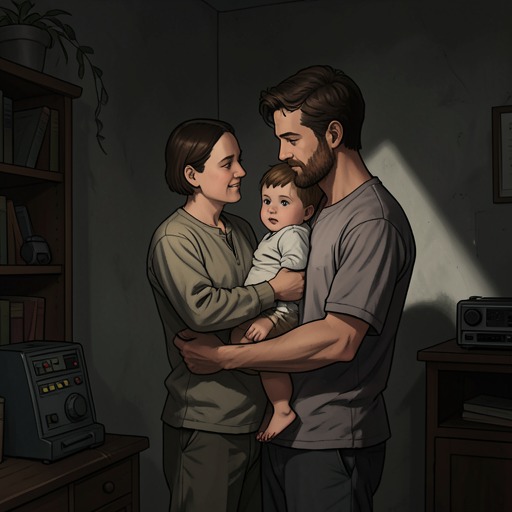
The DispossessedShevek and Palat’s father–son relationship is the formative bond of Shevek’s childhood and the enduring measure against which he experiences his estrangement from Rulag. Palat remains with his son through the years when sustained affection matters most, and his loyalty persists in Shevek’s memory after his death: when Rulag returns, Shevek defends the significance of Palat’s final act rather than letting his father become merely one name among the dead.
Identity and Background
Palat is Shevek’s father and the parent who stays with him during his early years. Rulag later explains that she and Palat kept Shevek with them in the domicile even after he was weaned, because they both wanted to. She describes those first years as essential to an individual’s development and says that affection provides the beginning from which fuller socialization can grow. Her account establishes that Shevek’s early family life was not simply an impersonal arrangement: Palat was present, and the child had a sustained parental bond.
The parents’ relationship does not remain intact. Rulag says that she was willing to continue the partnership and tried to have Palat posted to Abbenay, but no suitable opening appeared in his line of work, and he would not move without a posting. At first he wrote to Rulag sometimes to tell her how Shevek was; later, he stopped writing. The evidence presents the separation through work postings, incompatible circumstances, and the fading of communication, rather than through a single decisive rupture. In Shevek’s life, however, Palat’s continued presence makes the difference between the parent who stayed and the mother who left.
Childhood, Care, and Separation
Rulag recognizes Palat as the parent who saw Shevek through his “integrative years.” She calls him supportive and parental, and contrasts that role with her own: work came first for her, she says, and she was not a parental presence in the same way. Her later admission makes explicit what Shevek’s experience has already established. He grew up with Palat’s care, while Rulag became someone he did not feel he had known.
When she asks whether he resents her failure to keep in touch, Shevek replies that he cannot resent her for not maintaining a relationship he never knew. Rulag answers that it mattered and still matters, but she does not erase the difference between her absence and Palat’s care. She says that Palat stayed with Shevek and supported him. The exchange gives their family history two competing perspectives: Rulag can name the importance of the early bond, but Shevek’s attachment belongs to the parent who lived it with him.
Palat’s Death and Shevek’s Response
By the time Shevek and Rulag meet again, Palat has been dead for eight years. He died in an earthquake in Wide Plains, where he had worked as a construction engineer for the community. A first quake damaged the learning center; Palat was among those trying to get children out when a second quake brought the building down. Thirty-two people were killed. Shevek had left to begin training at the Regional Institute about ten days before the disaster, so he was not there when his father died.
Rulag remarks that Palat had not been more than thirty-five and reflects on his death as that of one person among thirty-two. Shevek answers that the number would have been higher if Palat had not gone into the building. His reply does not deny the scale of the loss; it rejects a framing that would leave his father’s action indistinguishable from the statistic. Palat’s effort to help those trapped gives Shevek a concrete reason to insist that his father’s death mattered to others as well as to him.
Rulag had assumed Shevek would look like Palat, but observes that he resembles her, apart from his coloring. Shevek does not share the resemblance she expected; when she asks whether Palat stayed with him, he nods. Her response is that Palat was lucky. In the encounter, family likeness, memory, and care remain distinct: Shevek may resemble his mother, but the parent he remembers as having stayed with him is his father.
Relationship with Rulag and Lasting Significance
Rulag’s return brings the father–son bond into the present as a source of conflict. She tells Shevek that she is glad he is there, offers to introduce him to people in Abbenay, and says she has some understanding of his difficulties with Sabul and the Institute. She also says that reading his book has made her proud, while recognizing that her pride has a possessive, unreasonable quality. She is seeking a connection with the son she lost contact with, but Shevek sees her loneliness and pain as a threat to the loyalty he feels toward Palat. He resents that she has come to Palat’s son in her own need after leaving Palat when he needed her.
Shevek’s sharp reply—that it might have been better if Rulag had gone on thinking of him as a statistic—turns the language of numbers back on their broken family history. Rulag had described Palat as one of thirty-two dead; Shevek had insisted that Palat’s intervention changed the number. Now he uses the idea of being reduced to a statistic to express what it would have meant for Rulag to remain distant: not a remembered son with a claim on her, but an indistinct fact she could leave untouched. His answer shows that Palat’s loyalty has not made reconciliation with Rulag simple. It has given Shevek a clear standard of care, and that standard sharpens his hurt when his mother seeks closeness only after years of absence.